

Application of Advanced Oxidation Processes for Wastewater Reclamation in Agriculture

AOPsAdvanced Oxidation Processes (AOPs) are effective water treatment technologies that generate high reactive and non-selective free radicals, such as hydroxyl radicals (•OH), which can oxidize a wide range of compounds including Contaminants of Emerging Concern (CECs), persistent pollutants and micropollutants.
They are particularly useful for promoting water reuse and environmental protection.
In this project, photo-Fenton and ozonation will be tested as AOPs to treat several wastewaters coming from different environments with the aim of reclaiming water for agricultural purposes:
- Dairy Soiled Water contaminated by antibiotics (target pollutants: penicillin and tulathromycin, Irish demo site);
- Reclaimed water from a reclamation plant contaminated by pharmaceuticals (target pollutants: carbamazepine and sulfamethoxazole, Italian demo site);
- Surface water contaminated by pesticides (target pollutants: glyphosate and AMPA, Greek demo site).
Photo-Fenton process combines Fenton process (generation of •OH through the reaction between H₂O₂ and Fe²⁺ under acidic conditions) with UV or visible light to enhance •OH production rate and increase the efficiency of organic pollutant degradation. In this project Raceway Pond Reactor will be used to perform photo-Fenton experiments being a reactor configuration that has shown to be very effective for micropollutants removal. It is a non-concentrating low-cost device allowing continuous flow operation where the illuminated surface can be varied by varying the liquid depth. As UV-VIS source, (a) solar radiation or (b) UV lamps can be adopted.
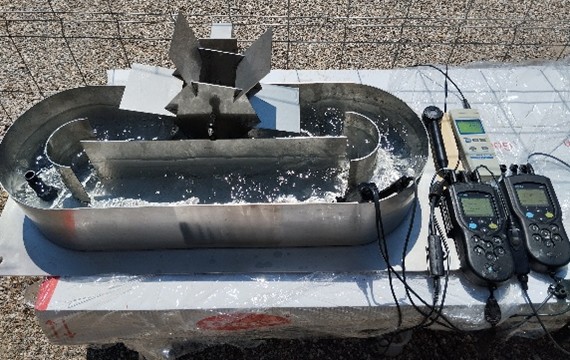

Ozonation process uses ozone (O₃) as a strong oxidizing agent to remove organic and inorganic pollutants from water. Under alcaline pH, O₃ decomposes in water to form •OH. Ozonation is a commercially available technique mostly used for disinfection, color removal, odor control, and degradation of micropollutants in wastewater and drinking water treatment.
Lab-scale optimisation of the AOPs will be performed at Leitat’s facilities with the aim of finding the operational conditions (H2O2 and Fe2+ concentrations, pH, Fe:chelating agent ratio, liquid depth, ozone dose, treatment time) that ensure maximizing pollutants removal while minimizing the operational cost. Synthetic wastewater simulating the specific wastewater from each demo will be used at this stage.
The most suitable technology and operational conditions will be validated at the different demo sites attending specific KPIs:
- IRISH DEMO SITE:
TECHNOLOGY TO BE VALIDATED: Chemical coagulation and separation step followed by a constructed wetland to treat the supernatant and the best performing AOP (among ozone and photo-Fenton).
KPIs: up to 90% CECs removal, and 95% E.coli inactivation
- ITALIAN DEMO SITE:
TECHNOLOGY TO BE VALIDATED: Solar photo-Fenton performed in a raceway pond reactor.
KPIs: 95% CECs removal, and 95% E.coli inactivation
KPIs: 95% pesticides (glyphosate and AMPA) removal
TECHNOLOGY TO BE VALIDATED: Modular constructed wetland followed by Solar photo-Fenton performed in a raceway pond reactor.
- GREEK DEMO SITE:
KPIs: 95% pesticides (glyphosate and AMPA) removal
TECHNOLOGY TO BE VALIDATED: Modular constructed wetland followed by Solar photo-Fenton performed in a raceway pond reactor.


